discipline
Discipline vs motivation: what actually gets you through day 47
Motivation gets you to the start line. Here is what keeps you going once the feeling is gone.

In this article
Quick answer
Motivation is a feeling that makes you want to start; discipline is doing the thing whether or not you feel like it. Motivation is great on day 1 but it comes and goes, so it can't carry a habit for months. Discipline is built from small promises you actually keep, a fixed time, a tiny minimum and a plan for bad days. Use motivation to begin and discipline to continue.
Everyone knows day 1. New shoes, new plan, new playlist. Then comes a grey Tuesday, the alarm goes off in the dark, and the person who made that plan seems like a stranger.
That gap between the plan and the grey Tuesday is what the whole discipline vs motivation debate is really about. They do different jobs, and most of us ask motivation to do a job it was never built for.
What is the difference between discipline and motivation?
Motivation is a feeling: the pull toward something because it excites you, scares you or matters to you. It shows up on its own schedule. A good video, a new year, a comment that stings, and suddenly you want to change everything.
Discipline is a decision you made earlier that you keep now. It doesn't ask how you feel. It asks, "What did I say I'd do at this time?"
The dictionary agrees: Merriam-Webster describes motivation with words like force, incentive and drive. A push, not the work itself. A simple way to hold the two:
| Motivation | Discipline | |
|---|---|---|
| What it is | A feeling | A habit of keeping your word to yourself |
| When it shows up | When it wants | When you planned it |
| Best for | Starting | Continuing |
| What it says on a bad day | "Not today." | "Just the minimum." |
| What breaks it | Boredom, bad weather, no results yet | Too big a promise, no plan for low days |
You need both. The trick is to stop waiting for the first one before you use the second.
Why motivation fades (and why that's normal)
Motivation fades for boring reasons. The new thing becomes normal, results are slow, and life adds a deadline or a late night. None of this means you are lazy or broken. It means the feeling did its job, which was to get you moving, and now it's off duty.
Two Paths, our life choices game, has a short story called 90 days that shows this with one runner on two paths: one runs on motivation, the other on discipline. On day 1 the motivated path shouts "NEW ME!! LET'S GO!" while the disciplined path just says "Same time tomorrow." By day 47 the scene simply reads "Day 47. Still no results." One path says "It's not working." and quits. The other says "Slow is still forward." On day 90, one of them is back at "Day 1… again."
The story ends on one line: "Feelings quit. Habits don't." That is the whole idea in four words.
How to build discipline when you don't feel like it
Discipline is less about willpower and more about design. Here is a plan you can start today:
- Pick one thing. Not a new life, one habit: a run, 20 minutes of study, phone out of the bedroom.
- Set a fixed time and place. "Every weekday at 6:00 AM, shoes by the door" beats "when I find time". A fixed slot removes the daily debate.
- Shrink the promise. Make the minimum so small you can do it on your worst day: one lap, one page, five minutes. On bad days the minimum keeps the chain alive.
- Prepare the night before. Clothes out, book open, phone charging in the kitchen. Fewer steps, fewer excuses.
- Write down the bad-day version. Decide now what you'll do when it rains, when you're tired or when you've missed a day: "If it pours, I do 15 minutes indoors." A plan made in advance is much easier to follow than a decision made in the moment.
- Track days, not results. Results are slow and noisy, and that is often exactly when people quit. Counting the days you showed up gives you something to be proud of before the results arrive.
- Never miss twice. Missing one day is life. Missing two starts a new habit: not doing it. If you skip a day, make tomorrow a minimum day, no matter what.
Small promises are where discipline comes from
The With Yourself role in Two Paths is built from everyday moments like these. Its meter is discipline and self-respect, and one moment is simply: "6:00 AM. The gym alarm." Pick "Snooze." and the game shows "Five minutes became “tomorrow”." Pick "Feet on the floor." and you see "You didn't feel like it. You went anyway. That's the habit."
Another moment is about something smaller: "You promised yourself no sugar this week. There's cake at work." One answer is "One piece won't hurt.", and the game's line for it is "It didn't. But the promise did." The other path, "Take a coffee instead.", ends with "Small promises kept make you trust yourself."
That last line is the quiet engine of discipline. Every small promise you keep is a vote for "I'm someone who does what I said." Every one you break is a vote the other way. After enough votes, you start to believe the result.
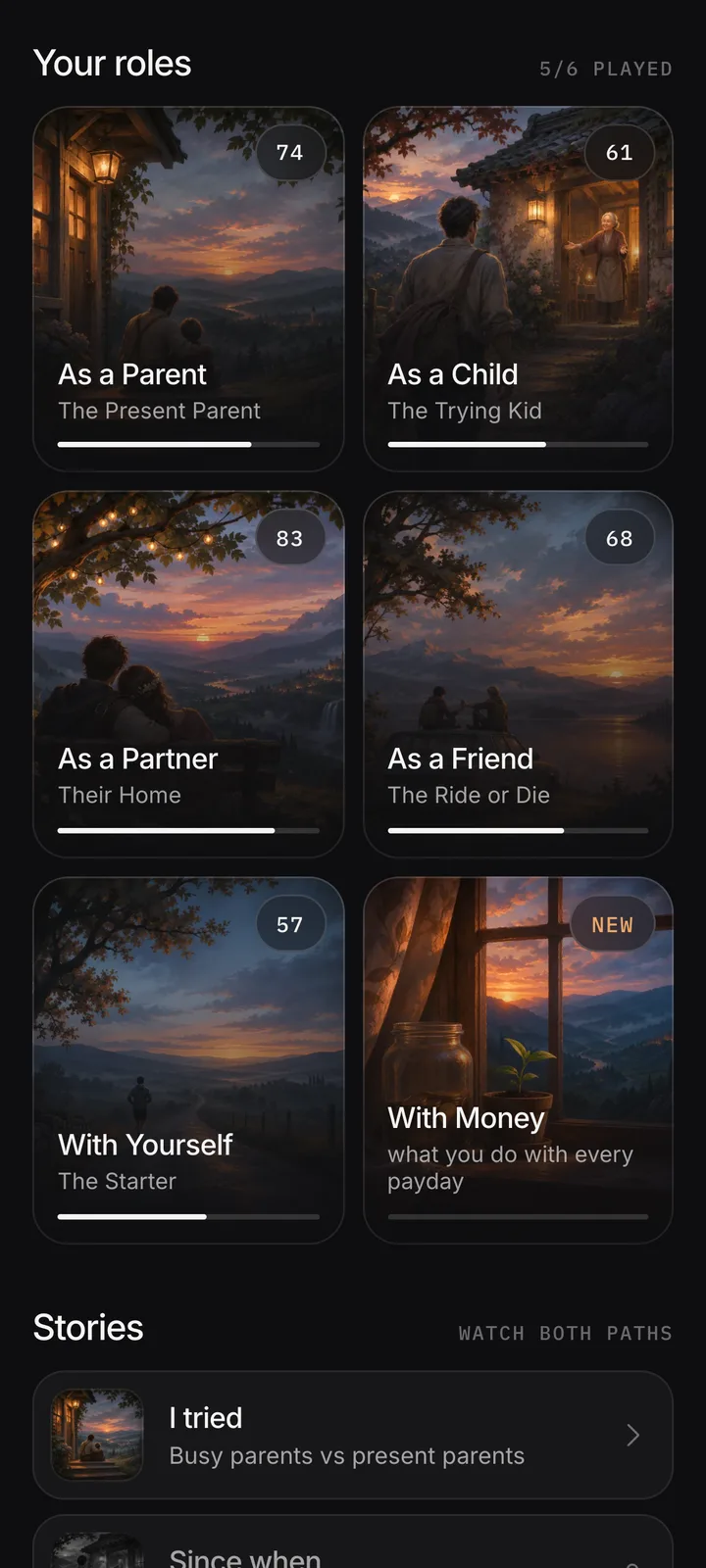
The titles in that role move in five steps as your score changes: The Quitter, The Someday One, The Starter, The Grinder and Unstoppable. Every role starts at 50, so everyone begins in the middle. And the 90 days story unlocks once your With Yourself score reaches 60.
Where motivation still helps
Discipline gets most of the credit, but motivation is not the enemy. Use it on purpose:
- To start. When you feel the spark, use it to set things up: choose the time, buy the shoes, plan the minimum. Turn the feeling into a structure before it fades.
- To remember why. Write one sentence about why this matters to you and keep it where you'll see it. On day 47 you won't feel it, but you can still read it.
- To celebrate. Reaching a streak or a milestone gives you a small boost. Let it count.
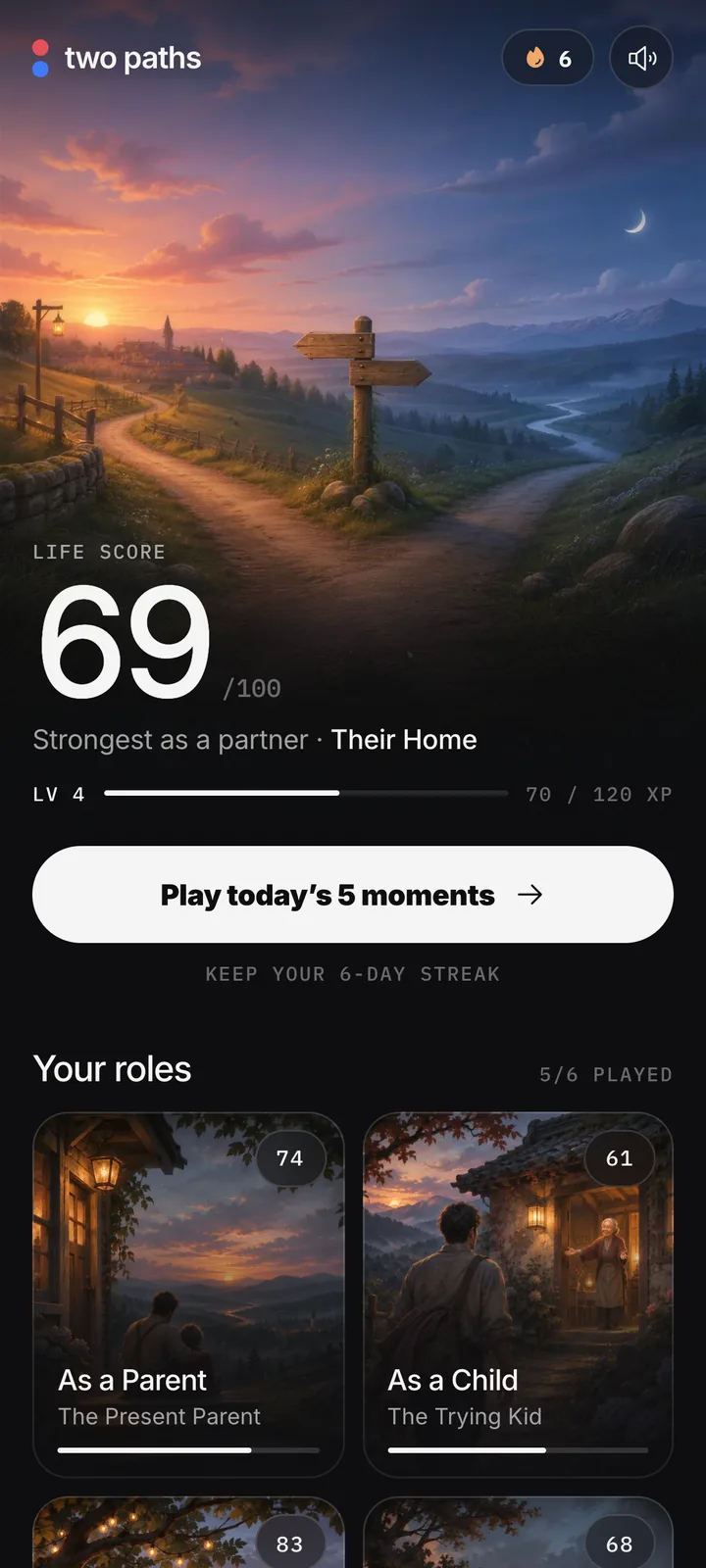
If you like a reminder on your phone, a streak can help too. In Two Paths, playing on consecutive days builds a day streak, and the home screen nudges you with a line like "Keep your 6-day streak". Same idea: showing up counts.
Practise the choice in twelve seconds
Real discipline happens in small, fast moments: the alarm, the last video at 1 AM. Two Paths puts those moments in front of you with two honest answers and twelve seconds to pick. If the timer runs out, you lose 3 points and the game says "Not choosing is a choice too." That's true of most habits as well.
It's a game, not a coach or a personal plan, but it is a quick way to notice which path you tend to take before you're standing in front of the real alarm. If you want more questions to think about, try our deep would you rather questions about life, and if your missed promises have hurt someone else too, our guide on how to apologize to your partner after a fight covers how to own it and say what you'll do differently.
FAQ
Is discipline better than motivation?
For anything that takes longer than a few weeks, discipline is more reliable, because it doesn't depend on how you feel that day. Motivation is still useful for starting and for reminding you why you began. The best approach uses both.
Can you have discipline without motivation?
Yes. That is most of what discipline is: doing the minimum you promised on days when the feeling is gone. A fixed time, a tiny minimum and a plan for bad days make it much easier.
What is discipline vs motivation vs consistency?
Motivation is the feeling that makes you want to act. Discipline is choosing to act anyway. Consistency is the result you see when discipline repeats over weeks and months, the long row of days you showed up.
How do I get back on track after missing a few days?
Don't try to make up for lost days. Pick your smallest minimum and do it today, then again tomorrow. One missed day is normal; the goal is to stop the second one, not to be perfect.
How long does it take for a habit to feel automatic?
It varies a lot from person to person and from habit to habit, so be wary of exact numbers. Simple habits at a fixed time tend to get easier sooner. Track the days you show up rather than counting down to a magic date.